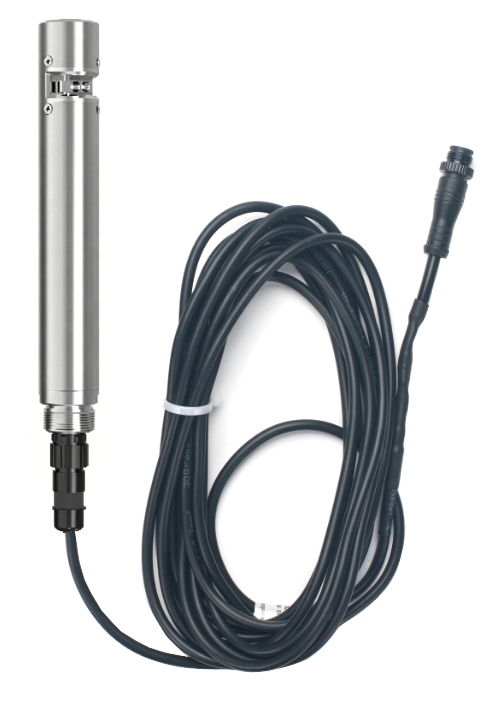
DR-COD -- Chemical Oxygen Demand Sensor
1. Introduction
This digital chemical oxygen demand (COD) transmitter for routine water quality monitoring utilizes the proven dual-wavelength UV absorption method, requiring no chemical reagents. A modulated light signal reduces visible light interference, while a dual-optical path system provides turbidity compensation. A built-in temperature transmitter provides automatic temperature compensation, making it suitable for long-term online monitoring.
1.1 Features
- Measurement range: COD: 0 ~ 500 mg/L equiv. KHP; Turbidity: 0 ~ 200 NTU.
- Waterproof rating: IP68.
- Modulated light signal for reduced visible light interference, dual-path turbidity compensation, and automatic temperature compensation make it suitable for long-term online monitoring environments.
- RS485 communication interface: MODBUS RTU communication protocol allows for convenient connection to a computer for monitoring and communication.
- The ModBus communication address and baud rate are configurable.
- The device accepts a wide voltage supply, supporting DC 12-30V operation.
1.2 Specification:
- Power Input: DC 12~30V
- Power Consumption: 0.6W (Normal); 4.5W (Self-cleaning active)
- Interface: RS485. 4800 Baud Rate (Default)
- COD & Turbidity Range & Resolution:
- COD Range: 0–500mg/L
- Turbidity Range: 0–200NTU
- COD Resolution: 0.1mg/L
- Turbidity Resolution: 0.1NTU
- Temperature Resolution: 0.1°C
- Accuracy:
- COD Accuracy: ±5% FS equiv. KHP (25°C)
- Turbidity Accuracy: ±5% FS (25°C)
- Temperature Accuracy: ±0.5°C
- Repeatability: ±1% FS equiv. KHP (25°C)
- Working environment:
- Ambient Temperature: 0 ~ 40°C
- Flow rate: <3m/s
- Max Installation Depth: 2 meters
- IP Rated: IP68
- Max Pressure: <0.1MPa
- Wire length: 5 meters (Default)
- Lifespan: 18 months (Self-cleaning mechanism)
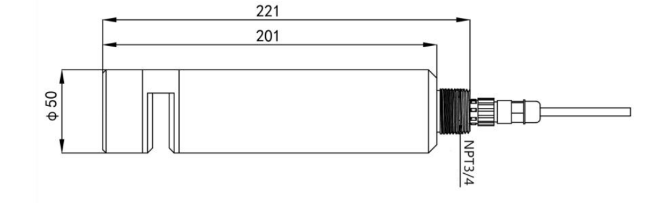
1.3 Mechinical Drawing
1.4 Maintenance
-
Measurement Window Cleaning: Regularly check the measurement window for attachments, oil films, or scaling based on the actual operating environment. Wash the window with tap water and wipe gently with a damp, soft cloth. For stubborn oil or dirt, add a small amount of household detergent to the water or wipe gently with alcohol. Do not scratch the optical measurement window.
-
Self-cleaning Brush Care: Periodically check if the self-cleaning brush functions normally and remains undamaged. Do not force the rotation of the self-cleaning brush shaft manually, as this may damage the internal motor mechanism.
-
Factory Maintenance: After approximately 18 months of continuous use, the transmitter must be returned to the factory to replace the dynamic sealing device of the self-cleaning mechanism. This interval can be adjusted depending on the configured cleaning frequency.
-
Calibration Frequency: It is recommended to calibrate the sensor every 3 months during long-term deployment. The calibration frequency should be optimized according to the fouling severity and chemical deposition rate of the water body.
-
Troubleshooting Unstable Data: If the measured COD or turbidity values become abnormally high, low, or continuously fluctuate, immediately check whether the optical measurement window is clean or blocked by air bubbles.
-
Waterproof Precautions: Ensure the cable plug and the device plug are completely locked and tightened before submerging the connector portion into water.
-
Handling and Storage: The transmitter contains highly sensitive optical and electronic components. Avoid subjecting the device to severe mechanical shocks, excessive cable tension, or prolonged exposure to direct sunlight. Do not touch the measurement window with bare hands.
1.5 RS485 Commands
RS485 signal:
Standard Modbus-RTU protocol, baud rate: 9600; check bit: none; data bit: 8; stop bit: 1
The register address is: 0x22
1.6 Query data
Example 1: Read the current dissolved oxygen and turbidity data from the device at address 22.
| Address | Function code | Register Address | Register length | CRC16 low | CRC16 high |
|---|---|---|---|---|---|
| 0X22 | 0X03 | 0X00 0X00 | 0X00 0X03 | 0X02 | 0X98 |
response:
| Address | Function code | Valid Bytes | Register contents | CRC16 low | CRC16 high |
|---|---|---|---|---|---|
| 0X22 | 0X03 | 0X06 | 0X03 0X16 | 0X39 | 0X7A |
0x000d, converted to decimal, is 13, a value 10 times the actual value, indicating a COD concentration of 1.3 mg/L.
0x00ce, converted to decimal, is 206, a value 10 times the actual value, indicating a temperature of 20.6℃.
0x000e, converted to decimal, is 14, a value 10 times the actual value, indicating a turbidity of 1.4 ntu.
Example 2: Set the deviation value for the current residual chlorine value of the device with address 01 to correct the value and send the frame: (If the current residual gas value output by the device is 7.90, the value needs to be corrected to 8.00, the difference is 8.00-7.90-0.100.1*100=10=>41200000 (floating point number), write 41200000 to the contents of the two registers)
| Address | Function code | Register Address | Register length | CRC16 low | CRC16 high |
|---|---|---|---|---|---|
| 0X22 | 0X06 | 0X00 0X51 | 0X00 0X0A | 0X05F | 0X4F |
response:
| Address | Function code | Register Address | Register contents | CRC16 low | CRC16 high |
|---|---|---|---|---|---|
| 0X22 | 0X06 | 0X00 0X51 | 0X00 0X0A | 0X05F | 0X4F |