Dragino Mesh Overview
Applies to: All Dragino Mesh Node products
Firmware: Dragino MeshNode firmware based on Mesh LoRa technology
Network: Dragino private LoRa Mesh network
| Category | Description |
|---|---|
| Quick Start for Dragino Mesh Nodes | Step-by-step guide to enroll, verify, and deploy a Mesh Node |
| Frequency Plan | Regional frequency information for Dragino Mesh Nodes |
| Mesh End Node | Mesh End Node Product Guides |
| Mesh Edge Gateway | Mesh gateway documentation |
| FAQ | Frequently asked questions |
| Developer Instruction | Firmware customization, compilation, and flashing |
1. Introduction
1.1 What Is Dragino Mesh?
Dragino Mesh is a private wireless sensor network developed by Dragino. Dragino extends the platform with device identity, private network enrollment, low-power scheduled wake-up, gateway time synchronization and configuration, and sensor data handling.
Sensor nodes collect and transmit data. Dragino Mesh gateways enroll and manage nodes, receive sensor data, and connect the network to management or application systems. Protocol conversion devices can connect Dragino Mesh to other networks when required.
Local Dragino Mesh communication does not require an Internet connection. Nodes, gateways, and a local management system can continue operating as a local network when Internet access is unavailable. A gateway or protocol conversion device can deliver data to an external system when required.
To deploy a node, follow the Quick Start for Dragino Mesh Nodes. For troubleshooting, see the FAQ. For firmware development, see the Developer Instruction.
1.2 Key Features
- Private local network: local node-to-node and node-to-gateway communication does not require a cellular network, SIM card, or Internet connection.
- No LoRaWAN infrastructure required: local operation does not require a LoRaWAN gateway or network server such as TTN or ChirpStack.
- Multi-hop coverage: data can reach the Mesh gateway through other nodes when the source node is outside direct gateway range.
- Low-power operation: enrolled nodes follow a scheduled, time-aligned wake-up cycle and sleep between active windows.
- Private enrollment: only enrolled nodes exchange normal business data and participate in network forwarding.
- Fixed Region: Region and LoRa parameters are set during manufacturing. The Mesh gateway and nodes must use the same Region.
1.3 Typical Applications
- Off-grid or private sensor networks in areas without LoRaWAN coverage.
- Agriculture and environmental monitoring, including soil moisture, EC, temperature, soil pH, and leaf wetness.
- Remote or industrial sites where deploying a LoRaWAN gateway and network server is impractical.
- Sensor networks that require intermediate nodes to extend coverage beyond one radio hop.
2. How Dragino Mesh Works
2.1 How a LoRa Mesh Works
Every node in a network uses the same radio parameters. A node only receives traffic from devices using compatible Region, frequency, bandwidth, and spreading-factor settings.
Nearby enrolled nodes can rebroadcast a packet so that it travels toward the Mesh gateway. Before rebroadcasting, a node briefly checks whether another node has already relayed the same packet. This managed forwarding reduces unnecessary duplicate transmissions.
A hop limit caps how many times a packet can be rebroadcast. For business data, the hop limit is selected dynamically from recent gateway time packets within the range 2 to 7. When no recent samples are available, 5 is used.
While a node is asleep, it cannot receive or relay data. Mesh coverage therefore depends on scheduled wake-up times, installation positions, antenna height, obstructions, and gateway coverage.
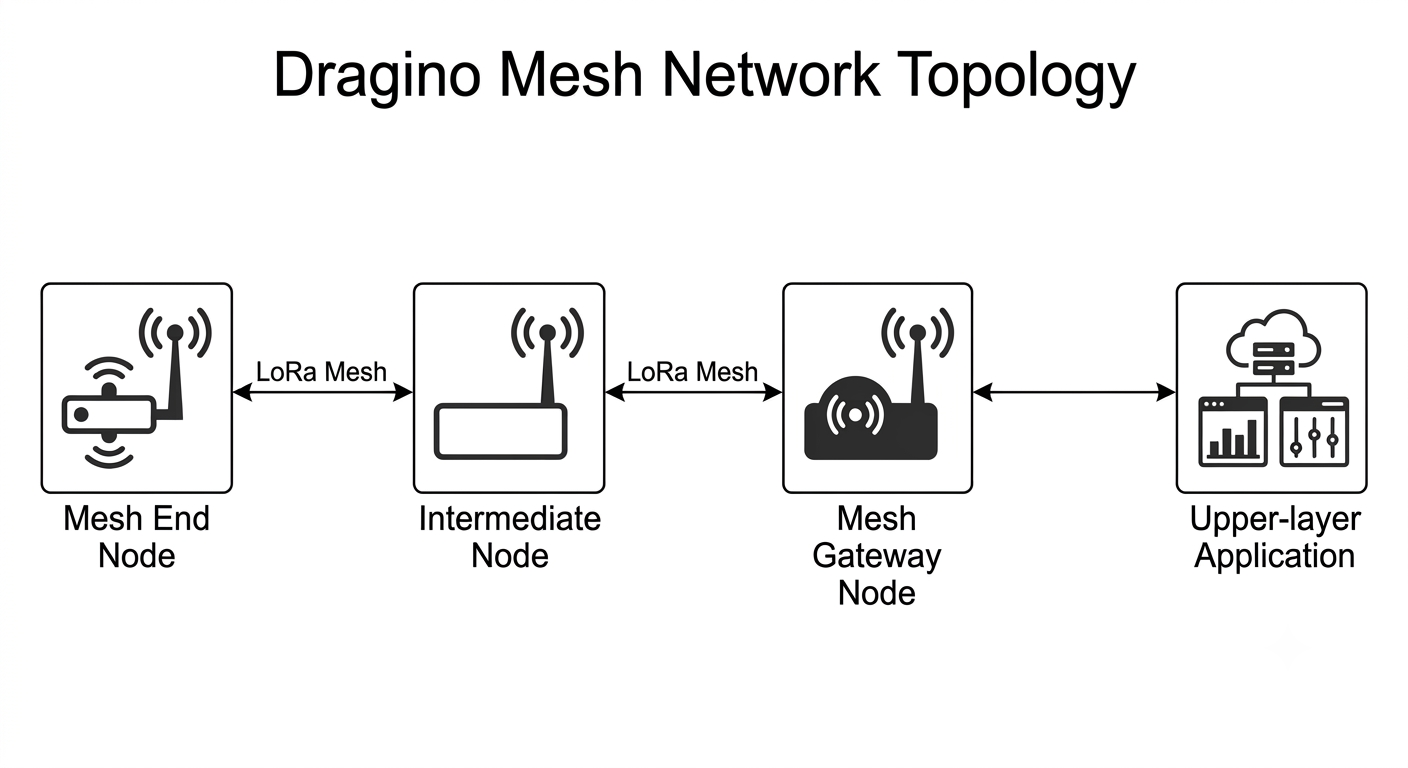
2.2 Network Roles and Components
| Role | Main Responsibilities |
|---|---|
| Sensor Node | Stores its device identity, wakes according to the configured schedule, collects sensor readings, transmits application data, and can relay packets while awake after enrollment. |
| Dragino Mesh Gateway | Enrolls and manages nodes, provides time and configuration services, receives application data, and connects to a management or application system. |
| Protocol Conversion Device | Converts data between Dragino Mesh and another network. For example, Mesh-to-LoRaWAN forwards Mesh data to a LoRaWAN network. |
| Management Interface and Tools | Enroll, configure, maintain, and diagnose devices through a gateway, Bluetooth, or the node's internal serial interface. |
| Application System | Stores, displays, processes, generates alerts from, or forwards sensor data. |
2.3 Frequency and Regions
Each Mesh device ships with a fixed Region and LoRa parameters set during manufacturing. For EU, the parameters are 869.525 MHz, SF11, BW250, and 22 dBm. The Mesh gateway and all nodes must use the same Region. For the full list of regions and frequencies, see the Frequency Plan page.
2.4 Mesh Business Data
Every business payload uses a fixed 14-byte common header, followed by a type-specific DATA block:
| Byte(s) | Field | Format | Description |
|---|---|---|---|
| 0 | version | uint8 | Payload version, currently 1 |
| 1 | data_type | uint8 | Selects the DATA layout |
| 2–5 | utc_time | uint32 LE | Unix UTC time in seconds; 0 means invalid |
| 6–13 | dev_eui | 8 bytes | Device EUI in standard display order |
| 14… | DATA | variable | Type-specific fields |
The fields following the common header depend on data_type. For the complete DATA layout, see the Mesh Payload section in the corresponding Mesh End Node Product Guide.
2.5 Dragino Mesh vs. Dragino LoRaWAN
| Dragino Mesh | Dragino LoRaWAN | |
|---|---|---|
| Topology | Mesh; enrolled nodes can relay | Star; end nodes communicate with a LoRaWAN gateway |
| LoRaWAN gateway required for local operation | No | Yes |
| Network server required for local operation | No | Yes |
| Node roles | Unenrolled node, enrolled node, Mesh gateway | End node |
| Reach beyond direct radio range | Yes, through enrolled intermediate nodes | No |
| Typical use | Off-grid or private sensor networks | Standard LoRaWAN deployments |
3. Models
3.1 Compatible Models
All Mesh models share the same base platform (STM32WLE5JC MCU with an integrated SX126x-class radio). Each sensor variant uses a separate firmware build.
| Model | Measured Parameter(s) | Firmware Status |
|---|---|---|
| SN50V3-MS | Base or general-purpose node without a dedicated onboard sensor | Available |
| S31B-MS | Temperature and relative humidity | In development |
| SE01-MS | Soil moisture, EC, and soil temperature | In development |
| SE0X-MS | Soil moisture, EC, and soil temperature | In development |
| SPH01-MS | Soil pH and temperature | In development |
| LMS01-MS | Leaf wetness and leaf temperature | In development |
| SDI-12-MS | SDI-12 sensor interface | In development |
| CPL03-MS | Pulse/Contact | In development |
| SVC01-MS | To be confirmed | In development |
Each model has its own page under Mesh End Node with product specifications, configuration, wiring, and supported profiles.
3.2 Related Pages
| Category | Description |
|---|---|
| Mesh End Node | Mesh sensor nodes and Product Guides |
| Mesh Edge Gateway | Gateway setup and data handling |